Min Kyu Kim delivered two invited talks at Seoul National University in Seoul, Korea this July. He gave a lecture hosted by the Center for Future Education Innovation and the Educational Technology Research Society, titled “Disruptive AI in Education: Opportunity or Threat for Educational Technology Research?”
Kim introduced the AI² Research Laboratory’s mission to design AI-based learning environments and highlighted major NSF-funded projects, including AI-ALOE, IUSE, and SaTC. He examined how advances such as large language models are reshaping theories of learning, altering concepts of expertise, problem solving, and pedagogy. He argued that instructional practices must adapt to balance product and process, redefine the boundaries of cheating and problem solving, and support human AI collaboration. He concluded that disruptive AI should be seen as a catalyst for reimagining research and practice in education.
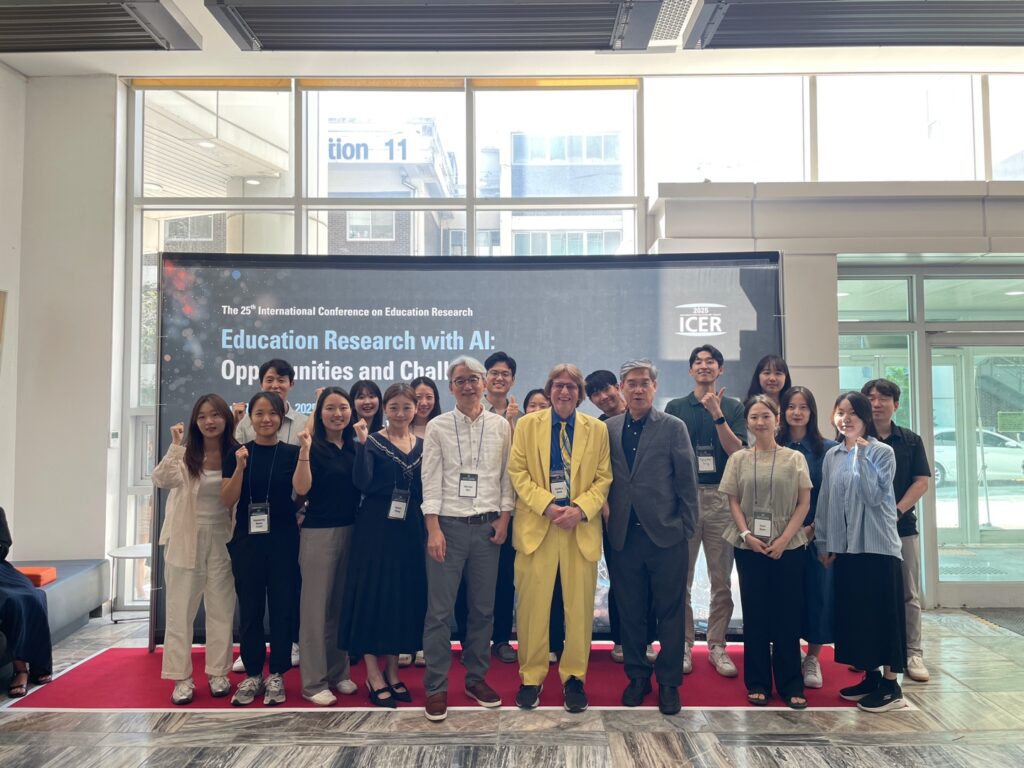
Kim also spoke at the 25th International Conference on Education Research (ICER), as one of 18 invited speakers. His talk, “AI for Education: Use-Inspired Approaches and Insights from NSF-Funded AI Institutes,” profiled initiatives across five NSF Institutes, including AI-ALOE, that address challenges from speech language services to large scale adult learning.
Drawing on his own work, Kim described shared strategies such as collecting large datasets, deploying AI in authentic contexts, and developing multimodal AI agents. He highlighted the SMART technology project, which integrates generative AI with human in the loop processes to revise learning materials. He showed how this approach improves concept learning while advancing both educational research and AI design.